
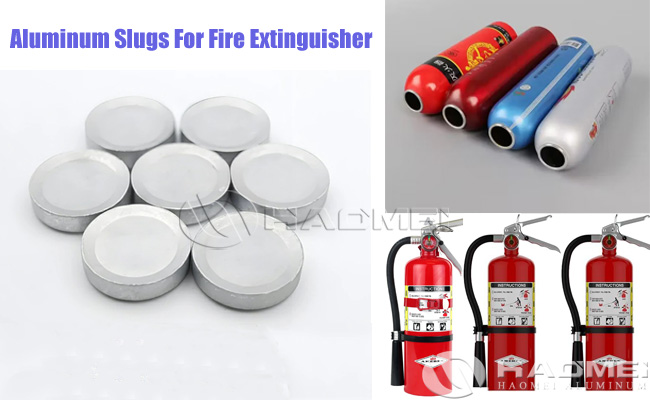
Small fire extinguishers are designed to be lightweight and easily accessible, while also being durable enough to withstand years of storage and occasional drops. Their cylinders are typically formed via a single-step impact extrusion process using a high-purity aluminum slug, resulting in a seamless body where the base and walls are integrated into one piece. 1070 aluminum slugs are the ideal raw material for these cylinders: with a purity of over 99.7%, they offer excellent softness and superior metal flow, providing a distinct advantage when forming the thin walls of small-scale cylinders. Getting the material selection right ensures a smooth process for subsequent stages, such as hydrostatic testing and filling.
Why 1070 Aluminum Is Preferred for Small Cylinders?
1070 is a grade of commercially pure aluminum, designated as EN AW-1070A under European standards. It contains at least 99.7% aluminum, with maximum limits of 0.25% iron, 0.20% silicon, and 0.04% copper, ensuring a very low total impurity content. In the O-temper (annealed) state, it features a tensile strength of 75–105 MPa, a yield strength of at least 25 MPa, an elongation of 25%–35%, a Brinell hardness of approximately 25 HB, and a density of 2.71 g/cm³.
This level of strength is well-suited for the requirements of small fire extinguishers. The operating pressure for the cylinders of portable dry-powder and water-based fire extinguishers typically ranges from 0.8 to 1.2 MPa, with a hydrostatic test pressure of approximately 3.0 MPa. For small, disposable aerosol-type fire extinguishers, the burst pressure must be at least 18 bar, and the pressure resistance must be no less than 10 bar. The cylinder material must prioritize plasticity and microstructural uniformity, ensuring that the metal flows evenly upward under the impact of the punch—thereby preventing cracks or localized thinning of the cylinder walls. 1070 aluminum slugs is copper-free and offers excellent corrosion resistance, ensuring the cylinders remain resistant to corrosion during long-term storage. Furthermore, its high purity provides a practical advantage: fewer impurity particles result in less wear on the die edges during the extrusion process, which in turn reduces the likelihood of pinholes or scratches appearing on the cylinder walls.
Specifications and Tolerances
Haomei Aluminum supplies 1070 aluminum slugs for fire extinguisher cylinders in an O-temper (annealed) state. These slugs are available in thicknesses ranging from 0.8 to 30 mm and diameters from 4 to 250 mm; for small fire extinguisher cylinders, the typical range is 60–150 mm in diameter and 5–15 mm in thickness. Products are manufactured in accordance with EN 570:2007, with chemical compositions adhering to the EN 573-3 standard. Inspection documentation is provided per EN 10204, with 3.1 certificates available upon request.
Tolerances for the blanks vary by size category: for diameters between 10 and 60 mm, the tolerance is ±0.03 to ±0.04 mm, while for the 120–150 mm range, it is ±0.08 mm. Thickness tolerances are categorized as follows: ±0.03 mm for 2.8 mm thickness, ±0.05 mm for 8.5 mm, and ±0.07 mm for 12 mm. For products featuring a center hole, the eccentricity of the hole must not exceed 0.15 mm. Additionally, the thickness of a circular slug should not exceed its diameter; if it does, cut blanks (sawn or machined) must be used instead.
Surface finishes include bright, sandblasted, and tumble-polished options, selected based on the customer’s specific coating and pre-treatment processes.
Forming Essentials
During backward extrusion, the aluminum slug is struck at high speed by a punch, causing the metal to flow upward within the die cavity to form a seamless cylinder in a single operation. Three factors are critical for the slug: consistent individual weight, uniform microstructure, and a clean surface. Variations in weight can amplify wall-thickness discrepancies in the finished cylinder; during hydrostatic testing, failure typically occurs at the thinnest points.
Two Case Studies
A manufacturer of 1kg dry-powder fire extinguishers previously used slugs with high impurity levels, which occasionally led to cracking at the cylinder opening. By switching to a 1070-O alloy batch with more uniform grain size and hardness, the scrap rate during forming dropped from approximately 2.5% to 0.6%. Wall-thickness variation was stabilized to within 0.25mm, and the cylinders passed hydrostatic testing on the first attempt.
In another case—a 500ml disposable aerosol-style fire extinguisher—the thin walls made the product highly sensitive to weight. By controlling the weight of each slug to within ±0.8%, the filling-process dosage variance was stabilized, and customer complaints decreased significantly.
For the production of fire extinguisher cylinders, the requirements for 1070 aluminum slugs center on three key factors: purity, plasticity, and batch-to-batch consistency. By specifying the 1070 alloy in an “O” (annealed) temper—with tolerances and individual slug weights calculated based on the final cylinder dimensions—manufacturers can achieve a stable, high-quality yield on their impact-extrusion production lines. Please contact Haomei Aluminum for sample requests, technical alignment regarding the EN 570 standard, or batch inspection reports.
